Tuesday, April 03, 2007

Women 2.0

Go to www.women2.org to learn more

What is Women 2.0?

Women 2.0 connects like-minded, motivated young women in the Silicon Valley to swap energy, ideas, and experiences with each other.

We promote the collaboration and growth of women in entrepreneurship, technology, and business and provide opportunities for young women to interact with successful women from a broad spectrum of industries.


Copyright C. 2007 Rabita Technologies Inc
TechRabita and TheBuzz are trademarks of Rabita Technologies,Inc

Monday, April 02, 2007

Homeland Security wants master Key for the Internet

The US Department of Homeland Security is insisting that Verisign hand over the master keys of the Internet. If it succeeds, the US will be able to track DNS Security Extensions (DNSSec) all the way back to the servers that represent the name system's root zone on the Internet. Effectively it would mean that US spooks could snoop on anyone.


read more | digg story

Friday, March 30, 2007

RSS Feeder...feeding the Genie...SYNDICATING your FEEDS!

FeedGenie , operated by Arwanah LLC a Silicon Valley startup is a real RSS Feed Processor. It contains functions to find, subscribe, and upload RSS feeds. Feeds are stored in a hierarchical folder structure with the ability to create local feeds. Users can set feed sample rate can can assign search key words and extract feeds in user defined folders. It is capable of extracting podcasts, mp3, video, pictures etc. from RSS feeds and move them to folders unattended. A download manager which is integrated within FeedGenie does this. A monitor gives the status of multiple reads, space, searches and genie icons change color to show the progress. This tool is targeted to as an individual business intelligence tool, not just a feed reader.

You can download the professional FeedGenie feed processor and try one month of extended functions and features. If a license in not purchased it will turn into standard FeedGenie which has more functionality than most free readers.


Cpyright C. 2007 Rabita Technologies Inc
TechRabita and TheBuzz are trademarks of Rabita Technologies,Inc

Thursday, March 29, 2007

Silicon Valley silhouette...BOOMing or BUSTing

Silicon Valley, the High-Tech hub of the world. Technology is what drive the Valley from the individual contributors to the multi national corporations, all reap the harvests of a BOOMing economy. The Valley's back engine is kept running by a select group of smart engineers and entrepreneurs. Things seem to be abuzz again here with Web2.0 startup's popping up in every nook and cranny of the Valley, with backing of the whose who in the Valleys' private equity circle.

On the surface of things it would appear like that the Valley is coming back to life after its long slumber which began 4 years ago with the dot-com bust. But is the latest round of prosperity reaching the vast majority? As we don't only have entrepreneurs and top ranking CxO's residing here. How are the middle income workers and families fairing? Are they also enjoying BOOM time in the Valley?

According Channel5 CBS EyeWitness news the middle class in the Silicon Valley is worse of now than in the year 2000. According a new labor report prepared by Working Partnership U.S.A. shows that the vast majority of low and medium income are struggling to make ends meet.

This squeeze is not only experienced by the low and middle income Valleiites, but is also effecting life for your techies with an average take-home pay in the ball park of six-fugures. As the cost of living in this Valley has been on an exponential rise. Take the recent gasoline price hike to more than $4 per gallon at many Bay Area gas stations, which is above the National norm.


Copyright C. 2007

Saturday, March 10, 2007

SoundTagr...The YouTube for user generated Audio files...

soundtagr was first conceptualized back in December of 2006 by a well known serial entrepreneur of Pakistani-Canadian decent. His first startup is the successful web2.0 venture, YouSendIt.com based in the Silicon Valley and backed by Alloy Ventures and Sevin Rosen Fund, two of the Valley's well known and reputed Venture Capital firms.

The original concept that the founder, Khalid Shaikh shared with me over a delectable lunch at Shalimar-Sunnyvale in the early part of December 2006 centered around creating a site for user generated Audio files, and so the reason for the domain http://www.soundtagr.com, registered at GoDaddy.com. However, if you visit the site now you will find that the scope has been extended to include all sorts of files and thus we get filetagr.


The underlying idea behind filetagr is: web sites are generating millions in company revenue from user generated content, but the person creating that content never gets a share of that revenue. So filetagr intends to give the revenue back to the user.

So how does it work? After a user subscribes to filetagr they have an option to upload a file to share. Whether it be audio files, video or event documents the type of file is irrelevant. The fact of the matter is once you upload your file, you are given a unique URL to share with your social network of friends and co-workers. For each click from a unique IP address you will earn around $0.01.

To learn more about filetagr visit the filetagr blog.


Copyright C. 2007 Rabita Technologies Inc
TechRabita and TheBuzz are trademarks of Rabita Technologies,Inc

Friday, March 09, 2007

TellAPal: A Real World Referal System....


While LinkedIn gets all the glory for professional social networking, there is another fairly new professional social networking site, Tell-A-Pal is based on a simple premise: If you are a service oriented business or professional, your greatest source of new customers are your existing customers. So why not reward your existing customers for referring new customers? It makes sense. Tell-A-Pal is a service that helps other businesses setup a referral reward program.

Tell-A-Pal is a privately held company in the Silicon Valley, it is in the online referral business of facilitating businesses and professionals to reward existing customers for referring new customers. There site is currently down, though a few months back at a social gathering I was introduced by a common friend to the founder Faisal Qureshi, formerly from Sun Microsystem's, Faisal hinted at some exciting new developments along the lines of a social commerce site being developed.

Tell-A-Pal will be launched from one of the following domains which are currently parked and hosted by Yahoo-Inc.

http://www.tellapal.com
http://www.tellapal.org
http://www.tellapal.net


Copyright C. 2007 Rabita Technologies Inc
TechRabita and TheBuzz are trademarks of Rabita Technologies,Inc

Wednesday, February 21, 2007

Social Networking...transforming communities...


AtifsList logo developed courtesy Rabita Technologies, Inc


AtifsList is an ethnic centric mailing list that emerged out of a need similar to how CraigsList was started by Craig Newmark. The difference between the two is that AtifsList is specifically focused on providing information about events and the latest going ons in the San Francisco Bay Area, particularly in the small, yet vibrant Muslim and South Asian communities of the region.

The list founder Atif M Qureshi, a Pakistani-American fire protection engineer in the Bay Area founded the list out of a need of the hour where he being an extremely active social bee was dissatisfied with the Ad-Hoc scheduling of events in his community. He found it quite frustrating many a times where you had scheduling conflicts between multiple events in the region. Not to mention little background information to go by, thus in of March of 2006 we saw the emergence of AtifsList.

Mr. Qureshi decided to take it upon himself to try and bring order to a chaotic system in his community. In his listing he includes future events in the bay Area with details addressing the what, where, why and how, and reviews and ratings of past events. His ratings are based on a sampling of a segment of his reader base who normally attend the events he has listed.

One may see this as a repeat of the CraigsList story, however CraigsList is a universal list which fills the void in multiple areas, where as AtifsList is focused solely on a certain segment of the San Francisco Bay Area community. With a particular mission to transform the bay Area Muslim community into a progressive forward looking one, and bridging the gap between his community and mainstream America. This is the power of the web, enabling ordinary citizens like Mr Atif Qureshi with the tools to bring his community, which has been under scrutiny since the horrific attack of September 11, 2001 into the mainstream American limelight and portraying a positive truthful image.


Copyright C. 2007 Rabita Technologies Inc
TechRabita is a trademark of Rabita Technologies, Inc
making pristine connections...

Sunday, February 18, 2007

Light Computing - the web4.0 future is near...

What are these? Look like pens...


Pen's with hidden cameras? Interesting....


Now what is this...pens with hidden cameras on a stand...


Now see - a holographic computer or as recently coined web4.0 technology.

No words can adequately describe quite how breathtakingly cool this i.Tech Virtual Keyboard is. Bluetooth enabled, it uses infrared to project a clear and crisp keyboard onto your desktop, and then transfers your keystrokes via wireless networking to your PDA, Pocket PC or smart phone - it sounds far too futuristic to be true. But it's very much for real, and it's awesome.

This 22nd Century gadget is about half the size of your average deck of cards, sits wirelessly on any flat surface, and projects a red standard QWERTY-layout keyboard on any flat opaque surface. Using detection technology it "watches" your fingers hit the key locations it has projected, and then sends the keystrokes through to your PDA, smart phone or pocket PC via Bluetooth.

The projected keyboard is highly visible even in strong light (though it does of course look spectacularly cool in the dark). It's highly portable as well, though it will make you look a bit of a lunatic at the local, as you will look like you're typing on nothing more than the pub table (which also raises some serious health and safety concerns), and you will of course be interrupted every fourteen seconds with someone coming over and wanting to know where they can get one.

There is no cooler keyboard in the known universe.


Copyright C. 2007 Rabita Technologies Inc

Friday, February 09, 2007

A New Computing Paradigm....

On February 13th, 2007 D-Wave Systems, Inc a Canadian based Quantum Computing technology startup will be launching the worlds first commercially produced end-to-end Quantum Computing system powered by a 16-bit processor.

The live launch will take place at 8am at the Computer History Museum in Mountain View, California.

Following is a brief description about Quantum Computing.


[Note to view TechRabita from India, Pakistan, China or Iran please visit us through
our alternate site at http://www.pkblogs.com/techrabita. This is due to the fact that the blogspot.com domain has been blocked by the respective Telecommunication authority.]


What is Quantum Computing?

Quantum Computing is a form of computing that operates in the realm of Quantum Mechanics.

Quantum mechanics is a mathematical framework or set of rules for the construction of physical theories. For example, there is a physical theory known as quantum electrodynamics, which describes with fantastic accuracy the interaction of atoms and light. Quantum Electrodynamics is built up upon the framework of quantum mechanics. The relationship of quantum mechanics to specific physical theories like quantum electrodynamics is like a relationship of a computer’s operating system to specific applications software—the operating systems sets certain basic parameters and modes of operation, but leaves open how specific tasks are accomplished by the applications.

In a quantum computer, the fundamental unit of information (called a quantum bit or qubit), is not binary but rather more quaternary in nature. This qubit property arises as a direct consequence of its adherence to the laws of quantum mechanics which differ radically from the laws of classical physics. A qubit can exist not only in a state corresponding to the logical state 0 or 1 as in a classical bit, but also in states corresponding to a blend or superposition of these classical states. In other words, a qubit can exist as a zero, a one, or simultaneously as both 0 and 1, with a numerical coefficient representing the probability for each state. This may seem counterintuitive because everyday phenomenon is governed by classical physics, not quantum mechanics -- which takes over at the atomic level. [Click for an explanation on Classical bit Vs. Qubit]


Fig. 1: Mathematical depiction of Quantum states - above shown are two |0> and |1> states, which are vector quantities - below is a superposition or summation of the two states. The reciprocal of the square root of two are amplitudes defining part of the superposition is in the |0> state and
the rest is in the |1> state.


Note on the Notation:

In quantum mechanics a commonly used notation is referred to as the Bra-ket notation which describes quantum states. It was invented by Paul Dirac to intuitively describe quantum stats. It is also used to describe abstract vectors and linear functions in mathematics. It is called Bra-ket because the inner product of two states, say for example a x and y are denoted by a bracket . This can also be described with the integral symbol as

= Integral(x*y) dxdy

Where x* is a complex conjugate of x.

Most of quantum mechanics uses this intuitive notation which hides the underlying complexities of the mathematical description.

Why Quantum Computing?

You might be asking why we need to worry about quantum computing. Well I could state several reasons why quantum computing is important, but for the purposes of this report it would suffice to state three of most fundamental reasons:

1. Semiconductor Fabrication Costs:

With the increasing complexity of Integrated Circuits (IC’s) the over head costs of fabrication has been on a steady rise. The plot in Figure 1 depicts the cost of fabricating Semiconductors verse time.


Fig.1: Semiconductor Fabrication Cost increases with Time (Courtesy Scientific America, 2000)

2. Declining Number of Electrons per chip:

With the increasing density and reduction in physical size of the semiconductor chips die, the number of electrons per chip are on a steady decline and their quantum mechanical interaction is becoming more and more significant. The plot in Figure 2 depicts a decreasing of the number of electrons per chip with increasing time.


Fig.2: Declining Number of Electrons per chip (courtesy Scientific America, 2000)

3. Classical computers, which are based on binary 0 and 1, are not able to generate a true random set of numbers.

4. Quantum Computers are able to perform certain types of calculations that could be too lengthy for classical computers to perform.

To further learn about the theory behind quantum computing, I would strongly recommend the following text by Michael A. Nielsen, Isaac L. Chuang titled "Quantum Computation and Quantum Information".

In the meantime standby for news about D-Wave Systems, Inc's groundbreaking historical launch of the first Commercially produced Quantum Computing System.


Copyright C. 2007 Rabita Technologies, Inc

Friday, February 02, 2007

Blogger Philhantropy....a new paradigm to charitable giving...

Dave McMurty is a Silicon Valley professional working in corporate development and mergers and acquisitions has harnessed the power of viral marketing and social networking to raise more than $175,000 in 5 months to build 38 homes in Columbia. Listen to Bloggers Give Back on Voices of the Human Network, by Cisco Systems.

Through the power of the internet, Dave has succeeded in providing his reader base with an intimate and personal connection to the housing project in Columbia sanctioned by Habitat for Humanity.

This is indeed a paradigm shift to the traditional method of raising funds which is a thing of the past. This revolutionary model is easy and cost effective to implement - it would surely cut overhead costs of raising funds at excruciatingly expensive fundraiser dinners, allowing more fund to be channeled to needy families around the world.


Copyright C. 2007 Rabita Technologies Inc
TechRabita is a trademark of Rabita Technologies,Inc

Wednesday, January 31, 2007

Wikiasari - A new way of searching the web!

Recently the Wiki Foundation founder Jimmy Wales announced a new search engine that will be based on user inputs.

What does this mean for Google, which is by far the most extensively used search engine around the world? The search world is extremely fragmented, every few months we have new search engines popping up - from Yahoo! to Google to Chacha, Webcrawler and now Wikiasari. How much longer will this trend continue - is the search space headed for a new "dot.com bubble"? Who will be the victor over this newest battle being played out in the search world?

Whatever the outcome in the search space, it is surely going to be one that is most agile in performing user searches. User's are searching for engines that will provide them with the exact information in the shortest amount of time. No one wants to sift through a million search results only to find one or two useful ones.

Sooner or later we will be witnessing a new Internet revolution, one that is based on user inputs and provides the human element to the online world. This may very well come in the form of web4.0 or holographic technology, where users interaction will go beyond the mouse and keyboard. In fact will be based on web based interactions in virtual online venues. Very much along the lines of the concept of the HoloDeck as depicted in Gene Roddenburry's novel Star Trek.

Already companies like Cisco and HP have embarked in such a direction with there Video Conferencing technologies called Cisco TelePresence and HP Halo respectively. The key in these two Video Collaboration tools is in the experience. The Cisco TelePresence indeed give one the impression of being in the same room as other participants - this is definitely the next best thing to the HoloDeck.


Copyright C. 2007 Rabita Technologies Inc
TechRabita is a trademark of Rabita Technologies,Inc

Friday, December 22, 2006

Chaching to Google...Googling to Chacha....


Back in the 90's when the Internet was still in it's infancy there were all sorts of search engines poping up. The search space was the hot space to be in then, whether you were Yahoo!, Alta Vista, Webcrawler, Lycos, Alto AuctionSales it was boom time in the search world. The internet was starting to become the in thing then. The general public was a little aprehensive of this new phenomonon that Bill Clinton dubbed as the Information Super Highway. No one quite new what he meant by this term, everyone had there own version of what it meant. Or what is the internet...or inter-net...what is that, many across the nation and world were dump founded.

Putting up a basic html webpage, not even a full site was such a novelty. People would be awe struck, 'wow you did that'. The internet was seen as this geek creation that emerged out of the barracks of DARPA. Who would have thought that a few years later most of the world would be conducting business, interacting with friends, hosting e-conferences and e-workshops which are commonly known as webinars would be commonplace.

Then comes this concept of searching from your personal computer, searching for any and every type of information without leaving your home or office. Search for information without stepping into a library or bookstore. Who would have imagined that this would be possible. Schools and University professors actually discouraged their students from researching for data for papers and projects from the internet. Students who were caught using the internet search engines where severely penalized. This was not too long back, around the mid to late 90's.

Today, the search world is booming with Yahoo! and Google being the top search engines on the internet. There are other smaller search engines, however to the most part these little guys tend to end up using some aspect of Yahoo! and Google.

Both Google and Yahoo! have complicated search algorythms which are continually develop and upgrade. However, they do have limitations, for one searching for specific information still requires the human factor. Where the user has to have some skill in choosing creative search strings. Searching for specific information can take hours, and even then you may not be satisfied. Out of a thousand hits you may find perhaps ten hit that has some relevance to what you are searching.

Despite these issues in the search world, millions of people from around the world search the internet through one of their prefered engines, Google or Yahoo! are generally the case.

But that is about to change with the recently founded Chacha Live Search Engine. Chacha on the surface of things looks like any other search engine. In fact, when you first visit www.chacha.com your first thought will most likely be...'Oh my God, this is a Google copycat...' As the home page looks very similar to www.google.com. Even the logo could be seen as following a Google like style.

But you will notice one thing: there is an option to search with a guide. That is a real live, breathing guide. A human guide who you can speak to and who will help you locate what your looking for. Now this is an experience, recieving VIP service for free !

Literally it feels like VIP service, you feel like a VIP who is being served by a dedicated search consultant. It is a novelty in todays world, to be able to speak with a person via a text chat about information you are in need off. This is would appear to be the new wave in Information Technology--providing the Human Experience to all your online activities. Allowing the user to experience the online world with the human touch. Not just Chacha, but many internet companies are begining to realize the end-users need and demand for the human touch.

Search engines such as Chacha may very well be next distructive technology in the search space. Thus creating a cascade effect where other search companies will be forced to rethink there business and technology models. They sooner or later will have to look into providing the human element to their services, as the trend is appearing to go in that direction.

In the next several months we should be seeing some dramatic changes in the search world, Google most probably will attempt to acquire Chacha, or perhaps Chacha's user share will increase with more and more users opting to use www.chacha.com over www.google.com. This is similar to how Yahoo! search lost its user share to Google.

So are you going to Chacha or Google?


Copyright C. 2007 Rabita Technologies Inc
TechRabita is a trademark of Rabita Technologies,Inc

Thursday, December 21, 2006

Butchers go online @ ebakra.com

This is an Islamabad, Pakistan based venture, which has brought the local meet butcher online. It is quite an innovative business model utilizing the transactional technologies which by todays standards may appear archaic in the world of web2.0, web3.0, and tomorrows web4.0. However, one cannot discount the creative aspect of this model.

The world of the internet has opened up doors to unimaginable opportunities. Now you don't have to be a Silicon Valley based techie with access to loads of Venture funding. Anyone with an idea, anyone who is courageous enough and willing to take the plunge can use the web technologies to enhance their business.

Whether you are a Butcher (Kasai as they are known Pakistan) or say a sweeper (Jemadar as they are known in Pakistan), all you need is the courage to go out and present your idea to whatever and whomever will listen. No matter how ridiculous sounding it may be, someone out there will lead you in the right direction.

So whether it is an eButcher.com or a eSweeper.com or eJemadar.com, the sky's the limit, or rather not the limit to the infinit possibilities to explore.

With that we at TechRabita would like to wish all our readers Happy Holidays, Merry Christmas, Happy New Year and Eid-ul-Adha Mubarak.

Until next year Chao !


Copyright 2006 Abdulrahman Rafiq

Monday, December 18, 2006

The Sky's no longer the limit....

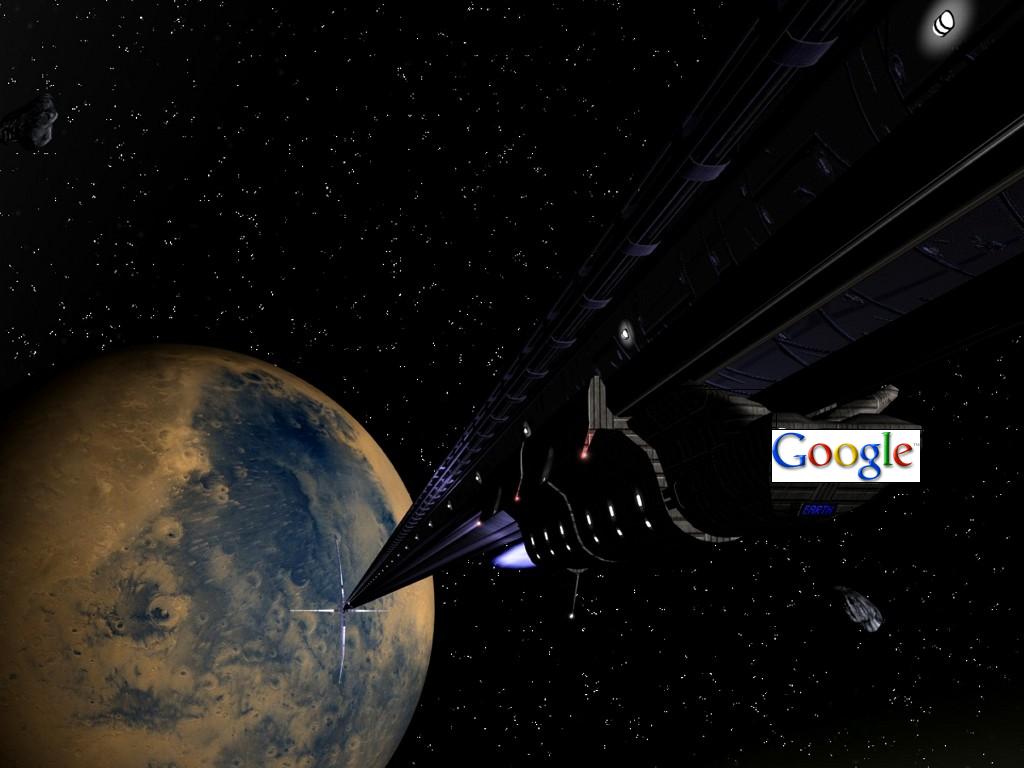
Today Google announced its intent to go boldly where no one has gone before, Space the final frontier. Google will provide end users with a conduit to journey into space and visit strange new worlds, witnessing births and deaths of stars, peeping deeper and deeper into deep space, thus fostering a new generation of space explorers who need not venture physically beyond their web browser.

The Google SpaceShip will be launching within the year, allowing its end users to travel for the first time into Space, to view NASA's massive data banks of images and videos it has collected over the years.

There seems no end in sight to what Google will do? From internet search to creating a virtual desktop (VDnet's) environment, where users instead of using there PC based word processors and spreadsheets can create, share, and store documents online. Thus, giving Microsoft a run for its money. Further, there is talk about Google venturing into voice communication, where it is working on the development of a unified data/voice communication system which will be based on the browser---thus giving companies such as Cisco a cause to be concerned about, is Google going to be a possible competitor or partner, is the question Cisco exec's are asking themselves?

Google has taken it upon itself to lead the internet generation into space. Where NASA and the Aerospace industry have failed to provide low cost public transport to Space, Google has the the next best solution to space travel. Instead of physically taking the public to space, it will bring space to them! Perhaps, the next step for Google is to partner or acquire Linden Lab's SecondLife. A social networking site, which unlike other internet social networks provides a 3D universe for users to create an alternate life, with your own personalized alter-ego or avatar. Now this site has not only attracted your typical techies and geeks, but has drawn attention from some of the worlds brand name companies who have setup shop in this virtual reality world.

A SecondLife partnership/acquisition would pave the way for Google to converge all its services into one virtual world. Thus placing Google ahead of the curve, positioning itself for the next big wave in the internet revolution. The wave of web4.0 which will integrate holographic technologies and enable users to create and visit remote worlds and destinations without leaving their homes. The Web4.0 revolution will transform our homes and workspaces into HoloDecks and HoloSuites as seen on Star Trek. Web browsing as we know it will be a thing of the past. Where user interaction with the web, will be like interacting in the Real world. Web4.0 will most certainly blur the lines between the Real-World (R-World) and Virtual-World (V-World).


Copyright 2006

The Techies 'i' ....Who own's it?

iPod, iTunes, iMac are all brands of Apple, it would appear like they have the rights to the iBrand, however with the recent launch of the iPhone it is clear that isn't the case. The iBrand has outgrown Apple and now can be considered a public domain branding tool for all to use.

The iPhone brand rights have belonged Cisco Systems, Inc since 2000, though Apple owned the iphone.com domain since 1999. And now Linksys, a subsidiary of Cisco has recently released it's newest product under this brand--a revolutionary product which could very be considered a destructive technology to the Telecommunication industry.

This techies i is a sought after brand in the Silicon Valley. Public companies to individual bloggers such as iFaqeer have used it. If you do a basic Google search, you will find many other products which have used the techies i, like iGive, iTools, iVillage, iFilm, iRobot

So who owns this techiies i? Apple? Apparently not, it is surely a public domain branding tool and can be appended before any other brand name like how about iGoogle, or iYahoo, or iCisco, or iPepsi. The point is, anyone or any corporation can use this techies i. So whomever is looking to enhance their brand image can do so by piggy backing on Apples with the use of the techies i.


Copyright 2006

Monday, November 27, 2006

Rise of the Silicon Valley: From Skockley Labs to Fairchild Semiconductor


On February 13, 1956, co-inventor of the transistor William Shockley formally announced the establishment of Shockley Labs, Silicon Valley’s first semiconductor company. In their modest Quonset hut laboratory on San Antonio Avenue in Mountain View, Shockley’s hand-picked team of some of the nation’s brightest young scientists and engineers developed innovative technologies and ideas that forever changed the way we live, work and play. To celebrate the 50th anniversary of this pivotal event in the history of our region, join technology historian Michael Riordan in a conversation between early Shockley employees and associates Jim Gibbons, Jay Last, Hans Queisser, and Harry Sello.


The Silicon Valley is more than a geographic location on a map. It is a phenomenon that has traveled the globe. From Bangalore to Lahore to Beijing to Tokyo. The idea of Silicon Valley has shown to be quite contagious. Infecting people after people, country after country and thus expanding itself to surpass physical boundaries.


Other than the people mentioned above, there are numerous other people whom you could refer to as the "unnamed" Foot Soldier or your all out Engineer who worked and continues to work day-in and day-out on the numerous projects that have kept the Silicon Valley flame lite.


Copyright 2006 Rabita Technologies INC

Wednesday, November 15, 2006

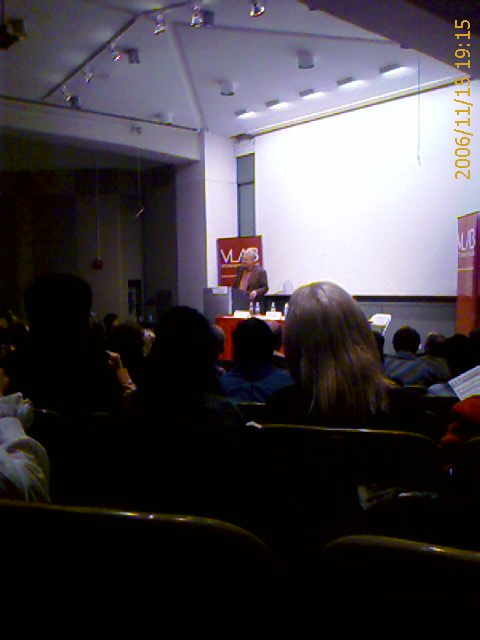
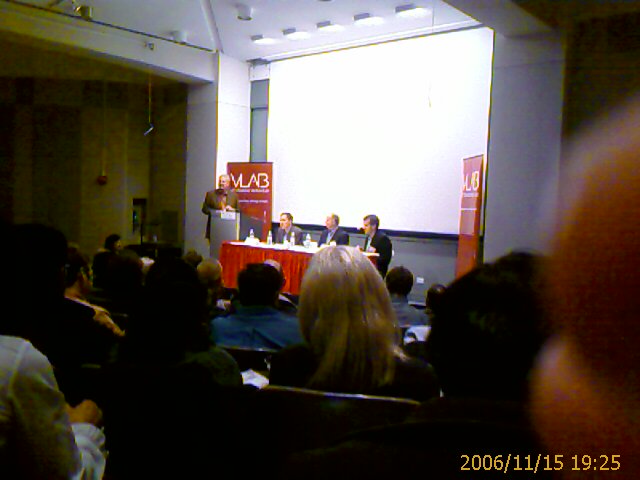
MIT/Stanford VLAB: An Evening with Geoffrey Moore

[Following are my unedited notes from the Nov15 Moore MIT/Stanford VLAB event. Will edit shortly]

Palo Alto Wednesday November 15, 2006:
The MIT/Stanford Venture Lab (VLAB) hosted a special evening with the acclaimed author and venture capitalists Geoffrey Moore and three veteran CEOs from online security and communication management companies (Barracuda Networks, Postini, and Proofpoint) who explored what it takes for businesses to thrive in this highly competitive global marketplace.

Geoffrey, whose books include crossing the Chasm, Dealing with Darwin, and Inside the Tornado, explored insights on the latest developments in the online security space., revenue generation, viral marketing, business model strategies, and other issues critical to the survival of startups.

In his keynote address Geoffrey went through a brief history of entrepreneurship and Venture Capitalist activities in the valley since before the 90's. He mentioned that when he first wrote "Crossing the Chasm" most of the entrepreneurs in the valley where former corporate guys. These were the initial pioneers whom were responsible for the first Tech boom. They were the founders of the likes of Intel, Fairchild Semiconductor, AMD, etc.

The mid-90's saw a second group of Entrepreneurs who came out of the Ivy league educational institutions such as Stanford, MIT, Berkeley, etc. These were "wicked smart people with an exceptionally higher IQ than their predecessors." This group of entrepreneurs set the 'Geek' trend. They were not business people, their motivation was to develop cool stuff. What they needed were business and finance people to help build business models around their "cool geek like" ideas.

Following this group we saw the dot.com era. As most remember it was boom time in the valley. The Valley was littered with dot.com's, it was the in thing then.

We are now back to an era where we need to build "real companies, not so much the picksey dust companies of the dot.com era." We need to build "earnest and thoughtful" companies.

These days to startup a "digital life" sort of venture one doesn't need much capital, and thus there is little impetus to approach VC's. Bootstrapping is the name of the game in this space, as costs are relatively low.

Traditionally VC's have invested in B2B and B2C companies. The Web x.0, or "Digital Life companies" started in kitchens or people garages. VC's weren't interested in such ventures.
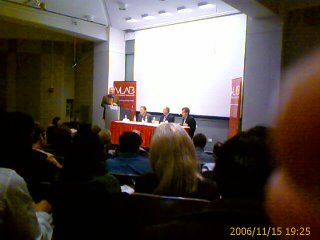
Immediately following is keynote, Mr Moore asked each panelists to say a few words about themselves and their respective business:

Dean Drako, President and CEO of Barracuda Networks spoke first: He said that Barracuda is into developing email filter spam appliances. The company was founded in 2003. They are the largest player in the anti-spam market. Their's is a low cost easy to use turnkey application. Their sales technique is simple, they ship customers a box. The company started out in a relatively untraditional manner by bootstrapping. It ran successfully for 2 years before outside investors were allowed. After which they received their first series-A VC funding from the Menlo Park based Sequoia Venture Capital firm.

Quentin Gallivan, President and CEO of Prostini: The company was founded in 2001/2002. We provide secure messaging and compliance services. Their business model is a software to service one delivered from data centers around the world.

Gary Steele. CEO Proofpoint: They deliver message security solutions to large enterprises such as Wellsfargo, Bank of America, etc. Our solutions deal with efficient management of email content. Gary was the 5th employee at Proofpoint. What interested him most about this company was the market. Everybody has to have a solution. Very dynamic and active.

[Following are points from the Panel discussion]

Moderator (Geoffrey Moore) asks the panel to ground us a little in what is meant by spam:

Gary Steele describes it as unwanted bulk email. This is not a virus per say, however there is a convergence we are seeing between viruses and emails. You could call this spam2.0, which is a "very dramatic threat." We are begining to see larger emails, spam embedded in images, documents and videos. This is very hard to detect and filter.

When ask about phishing and farming, Gary mentioned that this on the most part is a threat from Eastern Europe. Phishers and farmers are looking for personal information for quick financial gains.

Moderator: There is a tern 'zombie' used in the spam space. What does it mean? How do you know if your a zombie?

A zombie is when a program or virus is covertly placed our your local machine. On the most part these programs are dormant until activated by an external command. The best way to protect yourself from such spam/viruses is to use anti-virus and anti-spyware software tools. Or if your technological savvy enough then check your machines process controls. Look at the processes that are running.

Question from the audience: Which operating system do you support?

All the panelist responded with Windows. As windows over other OS is widely used. There is a greater threat on Window's based systems. If the trend continues and other OS systems such as Linux find themselves frequently attached, then perhaps we will consider supporting Linux.

Question from the audience: Are corporate networks being zombified?

"Absolutly, and most certainly." responded Greg Steele.

Moderator: What type of money does the typical spammer in your opinion make?

Panelist responded, in the millions per year.

Moderator: Is there any legislation dealing with spam?

There is a piece of legislation Congress approved which is similar to the 'donotcall' bill--called 'donotspam'. But it isn't effective, as it is not easy regulating spam, as all spammers need is " a rack in the Camen's".

Moderator: So speaking of "Category" when did spam hit the radar screen?

Spam has grown at an exponential rate. It started become a concern around 2002/2003, and now it is out of control.

In 2002 it became obvious that email is now part of our daily lives, both personal and corporate lives. And it had to be protected.

Barracuda Networks was founded on the premise of providing an easy to use plug-n-play appliance. Their aim was to launch the company to "sell a pain killer not s vitamin." As there are more dollars in selling pain killers and vitamin's. This is a better strategy for small businesses. The single item on small businesses agenda is to determine what created the 'category' across the chasm and find a quick solution.

Question from the audience on bootstrapping vs. going with a VC, or "VC'ing"?

If you can afford it, and afford to grow slowly then it's better to bootstrap rather than go with a VC.

Question: Tornado time, when is that?

Spam is growing at an astronomical rate. This market is currently in a tornado.
The U.S. spam rate is growing faster as compared to the rest of the world.

Question: How do you determine between GOOD and BAD mail? And what about confidentiality?

Panelist responded that confidentiality is a big issues. However, only BAD mail is stored on their respective systems. The GOOD mail is allowed to pass. As to differentiating between GOOD and BAD mail we use algorithms which are continually updated. Further, sometimes certain BAD IP addresses are blocked.

However, there is a limit to how aggressive you can get. As for all you know "Grandma's computer may be acting as a botnet." That is a computer which has a dormant program controlled virtually by a spammer. Spammer are becoming increasingly good at covering their tracks.


Copyright 2006 Rabita Technologies INC

Thursday, November 09, 2006

TelePresence---A Revolutionary Business Tool

Recently I had an opportunity to experience a TelePresence demo at Cisco Systems, Inc, in San Jose, California. It was an amazing experience. Myself and four other individuals where in a conference room split between two buildings separated a mile apart from each other.


The fact that we were physically sitting miles apart wasn't evident. Nor was the fact that we were interacting through a telephone and video screen. I literally felt like I was in the same room as everyone else.


TelePresence is only the begining, as this has the capabilities to expand into the world of web4.0 where Holography will be the centeral technology.


Sitting in this TelePresence conference truely felt like I was on a HoloDeck or HoloSuite as portrayed in the popular Science fiction Televeion serial Star Treck.


One may argue, that this has already been achieved by HP under the guise of the Halo video collaboration system. Howevever, all that glitters is not gold. As Cisco TelePresence may look like HP's Halo, experiencing is believing. I will admit I haven't personally experienced Halo, but based on third-party reviews I can safetly say that Cisco's TelePresence tops that of HP's Halo.


Following are several video clips discussing the Cisco TelePresence experience, earlier posted on YouTube


Cisco TelePresence


Vist to Cisco TelePresence


TelePresence--It's all about the Experience


TelePresence in the OR


Following is a servey on TelePresence by HPL


Copyright 2006

Wednesday, October 11, 2006

Second Life

This is like a virtual theme park. People go here for mostly the same reasons they go to Disneyland, DisneyWorld, etc. Where you get to spend DisneyDollars----just a whole lot cheaper than the $50 per day ticket or if you want to, purchase the annual Disney passport. But then the virtual life is meant to be cheaper---or why would corporations be so adamant in encouraging employees to limit physical travel and try to conduct long distant business through net-meeting, phone, video-conferences, etc?


Virtualization is not just a buzz word, or a mere fad--it is a real, living, breathing phenomenon, it is the future. A future where the lines between real and not-real are blurring.


Yesterday we were in the world of web 1.0, today its web 2.0, and web 3.0 which deals with mobile applications. Tomorrow we will see the world of web 4.0--the world of holographic or 3D applications, where you may start to experience say a vacation to Cancun in your single bedroom apartment, or visit your hometown or homecountry merely by the press of a button and your whole apartment turns into a holographic projection, where entities appear as real as the outside world. Sounds like science-fiction, a mere concept out of Gene Rodebury's Star Treck!


Following is a discussion I recently had with some folks on the sv-pak e-group list.


Commentator_1 wrote:


I attended an event on this last year, If you look at it carefully it is pretty scary n creepy how people getting involved in such virtual worlds


http://www.vlab.org/site/events/details.cfm?event=59#Rosedale


MC


On 10/6/06, Thread_iniatitor <*****@yahoo.com> wrote:


http://secondlife.com/


Second Life is a 3-D online world with a rapidly
growing population of more than 800,000 residents from
100 countries. The residents themselves create and
build the world, including landscapes, homes,
vehicles, nightclubs, stores, clothing, and more.


Copyright 2006 Rabita Technologies INC

Thursday, July 27, 2006

AlwaysOn Summit at Stanford & Technology CEO's Showcase


The World Business and Technology Televsion show covered AlwaysOn Innovation Summit at Stanford University from July 25 to 27, 2006. We interviewed Iqbal Syed, who is the Volunteers Co-Chair for the MIT/Stanford VLAB.


Please stay tuned for additional Video Clips from this AlwaysOn Summit.